- What Are These Versions, and What Do They Represent?
- Web 1.0: Everything You Need to Know
- Web 2.0: People Start Connecting Through Facebook
- Web 3.0: People Hate Banks and Want to Move Money Without Them
- Web 4.0: Companies Invent Artificial Intelligence to Increase Productivity and Output
- Web 5.0: Where Humans Barely Touch the Keyboard
- Where I Land in All of This
- FAQs
For SaaS / AI SaaS Founders · Beginner · Informational · Solves: Not knowing where AI actually fits in the bigger history of the internet, Treating AI like a passing hype cycle instead of a structural shift, Struggling to explain the pace of AI adoption to non-technical stakeholders, Feeling like it's too late to get in on the AI-driven web
Key takeaways
- Every web era looked like a toy or a scam before it looked like infrastructure.
- Web eras overlap rather than replace each other; only Web 1.0 has fully ended.
- Web 4.0 began emerging around 2022 with the release of GPT-3.0 and is still in its early adoption phase.
- Web 5.0 will likely mean agents running entire workflows end to end, with humans checking in only at decision points.
- Businesses still treating AI like an occasional chatbot are on the same footing as dial-up internet in 2004.
Classifying the web into eras from Web 1.0 to Web 4.0 may seem cliche, but I believe it's important. Each version represents a distinct period marked by major shifts in culture, the economy, technology, and many other areas of life. So if you're reading this, lay back, read on, and enjoy. Let's dive in.
What Are These Versions, and What Do They Represent?
The internet was, for a long time, just a bunch of computers connected through signals, cables, and phone networks, exchanging data and information. The important distinction between data and information is that data is plain, without any meaning. Information is data plus meaning.
For example, if I tell you “3000,” you have that number as data, but it doesn't necessarily mean anything.
But if I tell you “3000 soldiers will attack the enemy group on the hill at 2 AM,” then that data becomes information.
Digression, I know.
As I was saying, the internet was for a long time just a bunch of computers talking to each other. It wasn't a core part of our societal infrastructure the way it is today.
The internet as we see it today didn't just pop into existence out of nowhere. A bunch of people made infinite small tweaks and improvements to it, and in a few decades we ended up with something that seems almost alien: thousands upon tens of thousands of kilometers of cables connecting universities, militaries, and regular people, moving billions of dollars every month.
But in the history of the internet, there were major shifts, major improvements, that caused widespread global mania and major disruptions across hundreds of industries.
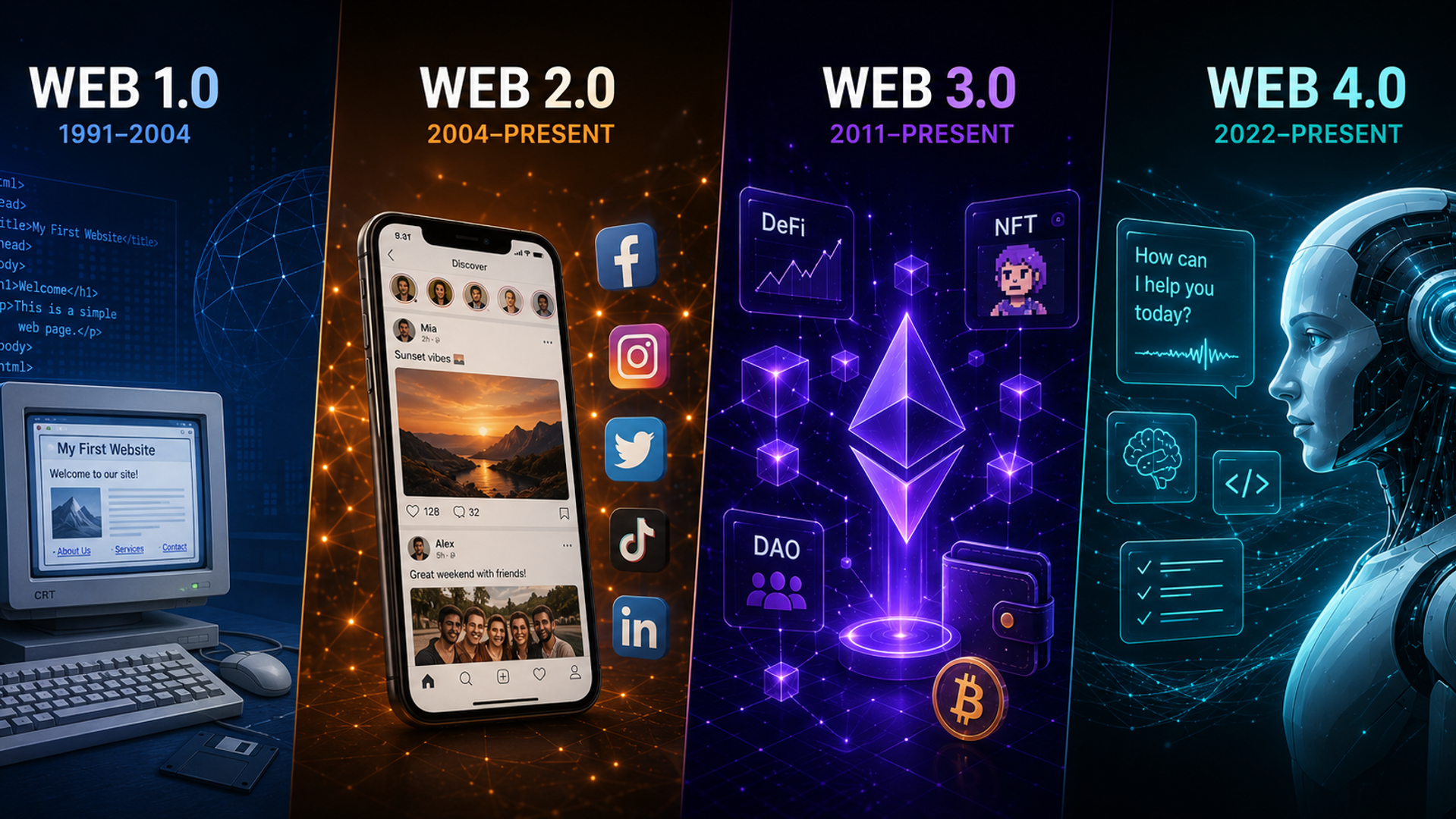
So far, we count four of those major shifts:
- Web 1.0 — A mostly static version of the internet where users primarily read information published by companies, institutions, and website owners. This era lasted from approximately 1990 to 2004.
- Web 2.0 — An interactive and social web where users create content, communicate, collaborate, and participate directly through platforms and applications. 2004 to present.
- Web 3.0 — A decentralized vision of the web built around blockchain, cryptocurrencies, digital ownership, smart contracts, and greater user control over data. 2011 to present.
- Web 4.0 — An emerging AI-driven web where intelligent agents can understand context, perform tasks, make decisions, and increasingly create or manage software autonomously. 2022 to present, and still emerging.
And Web 5.0 likely won't be created by humans at all, or only with minor human involvement.
Notice how only Web 1.0 is an era that has fully ended. That means these eras aren't mutually exclusive; for a new one to start, the previous one doesn't need to end. Blockchain is still innovating and creating new things, just not at the scale it did in its first few years. It's widely adopted now.
Web 4.0 is the newest, and it's in the same phase crypto was in from 2011 to 2018. We're deep in the early adoption phase, still figuring things out. Nobody knows anything for sure, it's an era of great uncertainty. And uncertainty doesn't pay, people like security.
Let's talk about these Web eras individually.
Web 1.0: Everything You Need to Know
Let's talk about this quickly, before I give my own thoughts I'll give you a list of facts about each web version.
- The World Wide Web was invented by Tim Berners-Lee in 1989.
- The first website went online in 1991.
- Web 1.0 was mostly a read-only web.
- Users mainly consumed information instead of creating it.
- Websites were built with static HTML pages.
- Content had to be updated manually.
- Interaction was very limited.
- Social media, likes, comments, and feeds did not exist.
- Most content was published by companies and institutions.
- Early websites used text, links, basic images, tables, and GIFs.
- Internet access was slow and often used dial-up connections.
- Browsers like Mosaic, Netscape Navigator, and Internet Explorer became popular.
- The dot-com boom made the web commercially important.
- The Web 1.0 era lasted approximately from 1991 to 2004.
This is perhaps the most important era, since it was the birth and start of everything we have today on the web. This is where it all begins, and it's probably the most successful invention of the last hundred years, despite AI and everything else. Nikola Tesla laid the foundations for electricity, connection, and so on, but the internet is a technology you simply couldn't explain to a Roman soldier a thousand years ago.
Let's move forward.
Web 2.0: People Start Connecting Through Facebook
- Web 2.0 made the internet interactive.
- Users could create and publish their own content.
- Social media platforms became dominant.
- Blogs, forums, comments, likes, and shares became common.
- Websites became more dynamic and responsive.
- Platforms like YouTube, Facebook, Wikipedia, and Twitter grew rapidly.
- User-generated content became one of the web's main features.
- Online communities and digital identities became more important.
- Cloud software and web applications replaced many desktop tools.
- Smartphones made the web constantly accessible.
- Large platforms collected and controlled huge amounts of user data.
- Advertising became the main business model for many free platforms.
- Algorithms began deciding what content users saw.
- The Web 2.0 era began around 2004 and remains dominant today.
Web 2.0 is the first era I vividly remember. In 2004 I was four years old. At that time we still didn't have internet in our household, and we were a pretty poor family back then.
My very first Web 2.0 moment that I vividly remember is creating my Facebook profile. It was my uncle, my mom, my grandma, and me at home. My dad was at work.
I think at that time the internet was still dial-up, or maybe it was the very first time we had cable internet.
We had a small workshop back then, and my dad and uncle would spend a good portion of their time working on computers there. They'd play games sometimes, fix computers for others, and so on.
So while my dad was at work, I'd spend time with my uncle at that workshop. I'd open Internet Explorer, go to facebook.com, and start creating my account.
We had an old camera, so we went outside and my uncle took a photo of me. I was a pretty fat kid, and I remember being ecstatic and smiling for the photo.
Then I tried to create the account, and it hit me with an error saying I was way too underage for Facebook. So what do I do? I say I'm way older than I actually am, and the account gets created.
I start adding friends and family. I still remember the old emojis, the old pinkish heart emoji, the old Facebook chat, the sound that popped when you got a message, all of it. Such nostalgic memories.
My second “aha” moment was with YouTube and watching my first YouTube videos. It was wonderful. Around 2008, the first Iron Man came out, then Transformers, then four years later we got Avengers.
The technology back then wasn't as polished as it is today, the UX wasn't nearly as well thought through, but for some reason every piece of tech felt so much simpler to use.
In 2011 I distinctly remember watching the trailer for Assassin's Creed Revelations. The song in that trailer was amazing. I'd sing it day and night.
Web 3.0: People Hate Banks and Want to Move Money Without Them
I don't think anybody expected Web 3.0 to become an entire era. People just wanted a more convenient way to move money without banks having oversight over the transactions.
Your first instinct might be, well, they were probably trying to do some criminal stuff. Ironically enough, the first few BTC transactions were used for exactly that kind of activity, moving value without government or bank oversight, and so on.
It was the wild west, completely unregulated, under the radar for years. Nowadays there's a coin for every stupid meme that exists, people move billions through it, it's regulated, banks have adopted it, and it's no longer the truly decentralized tech it used to be.
- Web 3.0 focused on decentralization.
- Blockchain became its main underlying technology.
- Users could own digital assets directly.
- Cryptocurrencies enabled online payments without traditional banks.
- Smart contracts allowed transactions to run automatically.
- NFTs introduced verifiable ownership of digital items.
- Decentralized finance offered financial services through blockchain networks.
- Digital wallets became important for identity and access.
- Applications were built on networks like Ethereum and Solana.
- Users were promised more control over their data and money.
- Many projects remained speculative and difficult to use.
- Scams, hacks, and market crashes damaged trust in the space.
- Web 3.0 began gaining major attention around 2014 and remains active today.
My personal experience with Web 3.0 is a bit rough. I invested about 25k into altcoins, and at one point I was down 20k. But that was my own mistake. I made the money back freelancing, invested it into better assets, and it's all good now. I learned from it and I'm making smarter moves going forward. No hard feelings, it is what it is. Onto new things now.
Web 4.0: Companies Invent Artificial Intelligence to Increase Productivity and Output
- Web 4.0 is centered around artificial intelligence.
- AI can understand language, images, voice, and context.
- Software can complete tasks instead of only showing information.
- AI agents can browse, research, write, code, and automate work.
- Applications can adapt to each user in real time.
- Software can increasingly update and improve itself.
- Natural language is becoming a new way to control computers.
- AI-generated content is becoming common across the web.
- Personal assistants can connect multiple apps and services.
- Permissions, security, and access control are becoming more important.
- Hallucinations are becoming a major software risk.
- Human work is shifting toward planning, judgment, and supervision.
- Web 4.0 began emerging around 2022 and is still developing today.
This is my second big internet “aha” moment. Web 4.0 started four years ago, in 2022, with the release of the first GPT-3.0 models. But personally, as a teenager, I was already heavy into AI. I used TensorFlow, and I tried building my own chatbot in C#, basically a bunch of if-loops with a more advanced TTS engine bolted on.
I managed to get it working around 2017 to 2018, to the point where it could open my browser, search the internet for the weather, and even answer questions, though “answering questions” really just meant grabbing the first few strings from whatever websites showed up on the first page of Google and handing them back to me.
Back then I used to dig deep into how neural nets work, how to train AI to play games for you, that kind of thing. It was quite fun. Then I went through a few rough teenage relationships, and, long story short, in 2022 GPT-3 comes out.
I'm not joking when I say there hasn't been a single day or month since it launched that I haven't used AI. I used to jailbreak it, I used the GPT playground to unrestrict it and make it purely unhinged. If you remember the DAN prompt, huge back then, I was in that all the way through to setting up agents with Claude now and automating tasks.
I've even built my own USA-based LLC, zednova.studio, an agentic-first agency that provides vertical AI integration for SMBs that don't have the time to do it themselves. Basically, we go into an SMB, figure out where AI can bring the biggest ROI in their workflows, and implement it.
Now a small prediction.
Web 5.0: Where Humans Barely Touch the Keyboard
I mentioned it at the start, so let's close the loop. Web 5.0 is still speculation at this point, nobody's writing quick facts about it yet because it hasn't fully arrived. But if the pattern holds, here's roughly what it looks like.
- Agents don't just assist with tasks, they run entire workflows end to end, with humans checking in only at decision points.
- Software increasingly writes, tests, and ships itself, with a human reviewing outcomes instead of code.
- The interface stops being an app or a website altogether. You just say what you want, and something orchestrates the rest across a dozen tools you never see.
- Ownership and identity questions get even messier, since now it's not just who owns this data, but who's accountable when an autonomous agent gets something wrong.
- Humans shift almost entirely into planning, taste, and judgment. The execution layer becomes invisible.
If Web 4.0 was “AI can do the task if you ask it,” Web 5.0 is “AI already started the task before you finished thinking about it.” We're not there yet, but you can feel the early edges of it right now: agents chaining tools together, models that plan multi-step work on their own, less and less of the process actually touching a human hand.
Whether that's exciting or terrifying probably depends on how much of your income depends on being the one doing the execution.
Where I Land in All of This
Here's the thing that stands out to me looking back at all four, soon five, eras: every single one of them looked like a toy or a scam before it looked like infrastructure.
Web 1.0 was “just some nerds with websites.” Web 2.0 was “just teenagers poking each other on Facebook.” Web 3.0 was “just criminals moving coins nobody can trace.” Web 4.0 right now still gets called a bubble by plenty of smart people.
I've been early, or at least early-ish, to most of these, not because I'm some genius who saw the future, but because I was curious enough to actually use the ugly, half-broken version of the thing before it became the polished version everyone else adopted later.
That's basically the whole thesis behind ZedNova. I'm not waiting for AI agents to become mainstream and safe before I build with them. I'm in the workshop right now, same as I was with my uncle in 2004, figuring out the ugly early version before everyone else shows up.
If you're running a business and still treating AI like a chatbot you occasionally ask questions to, you're where I was on dial-up in 2004. The next era isn't coming, it's already here, quietly rewiring how work gets done. Might as well get in early.
If you are watching search shift into generated answers, skip the shortcut lists. How AI Overviews actually select pages is the Google-specific version of that problem.
Sources & references